
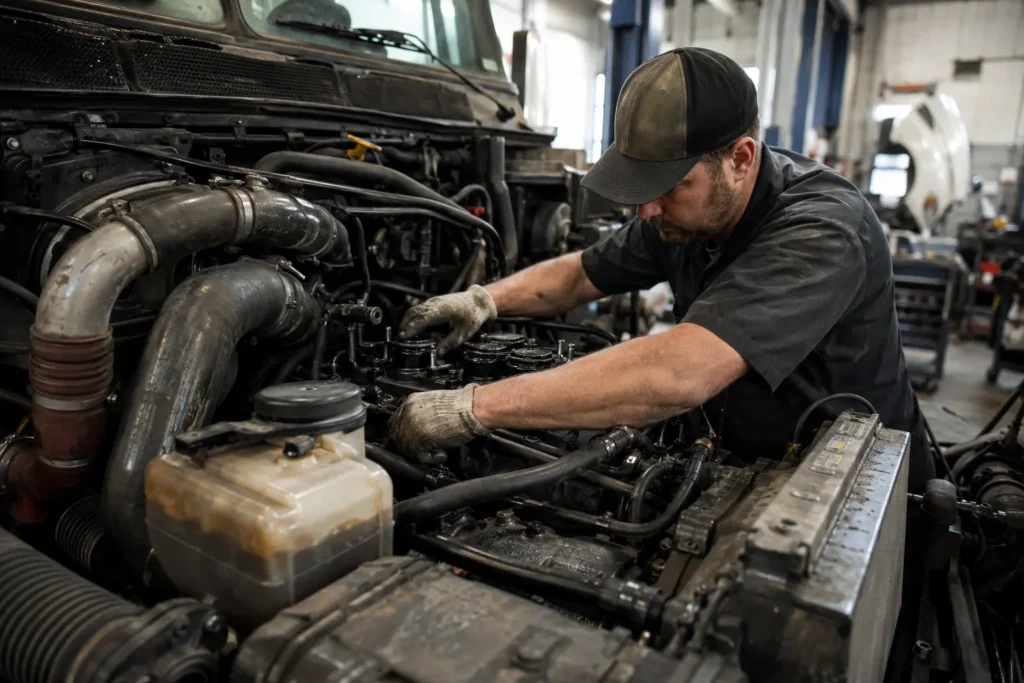
Diesel engines are engineered to go the distance. Half-million-mile Cummins engines aren’t folklore — they’re sitting in driveways and fleet yards across North America, still pulling loads on their original bottom ends. Freightliners and Kenworths routinely clock 700,000 miles before a major overhaul. But that durability isn’t automatic. It is earned through a specific set of maintenance decisions — and it can be quietly destroyed by a short list of avoidable mistakes. After 15 years in diesel repair and fleet operations, I’ve watched trucks with genuine half-million-mile potential die at 200,000. The engines didn’t fail. The maintenance programme failed them. Here’s what you need to know.
Key Takeaways
What Makes a Diesel Engine Different
Diesel engines outlast gasoline engines for reasons that go beyond reputation. The engineering differences are real, and they compound over hundreds of thousands of miles.
Compression ratios tell the first part of the story. Diesel engines compress air to ratios of 14:1 to 25:1 — far higher than the 8:1 to 12:1 typical of gasoline engines. That thermodynamic efficiency produces the torque diesels are known for, but it also demands heavier internal construction. Diesel pistons, connecting rods, crankshafts, and cylinder walls are all built to substantially higher tolerances than equivalent gasoline components. The result is an engine with considerably more material to absorb wear across its service life.
Operating RPM is equally important. A diesel producing 400 horsepower may cruise at 1,400 to 1,600 RPM, while a comparable gasoline engine runs at 2,500 to 3,000 RPM for equivalent output. Fewer cycles at lower loads, accumulated across hundreds of thousands of miles, mean dramatically less internal wear. The diesel ages more slowly at the same pace of work.
Diesel fuel itself contributes. It carries more energy per gallon than gasoline and contains lubricating properties that coat injectors and pump components during normal operation — a built-in mechanical advantage gasoline does not offer.
The engineering advantage is real. But it only plays out if the maintenance keeps pace with what the engine actually requires.
Oil Changes: Where Half-Million-Mile Trucks Are Won or Lost
If there is one maintenance decision that separates diesel trucks that reach 500,000 miles from those that don’t, it is oil change discipline. Not because it’s complicated — it isn’t — but because the consequences of getting it wrong are slow, invisible, and cumulative.
Modern heavy-duty diesel engines can tolerate extended oil change intervals with the right oil specification and a functional oil analysis programme. Professional fleet operations routinely run 15,000 to 20,000-mile change intervals without measurable wear penalty. But that’s not a license to skip changes or guess at intervals. It reflects how precisely engineered these engines have become — and how much they depend on oil quality staying within that precision.
What Degraded Oil Actually Does to Your Engine
Engine oil serves three primary functions: lubrication, cooling, and cleaning. As oil degrades through heat cycles and contamination, all three deteriorate simultaneously. Viscosity breaks down, reducing the protective film between moving surfaces. Additive packages — the anti-wear, anti-oxidation, and detergent compounds — deplete. Combustion byproducts, fuel dilution, and coolant contamination introduce compounds that accelerate metal wear and form deposits.
The damage from extended oil intervals doesn’t announce itself. There’s no warning light for ‘your bearings are experiencing accelerated wear.’ The truck keeps running, keeps pulling, keeps passing the basic checks. The evidence only appears months later — in elevated iron content on an oil analysis, premature bearing wear at a rebuild, or a failure that looks sudden but has been building since the third or fourth time someone pushed the oil interval past where it should have stopped.
The correct approach is interval-based changes keyed to the manufacturer’s specification for the specific duty cycle — not the sticker from the last quick-lube shop, and not the maximum interval from the owner’s manual applied uniformly regardless of operating conditions. High-idle operations, short-trip duty cycles, cold-weather starts, and towing at or near rated capacity all shorten the effective service life of engine oil compared to highway cruise operation.
The Cooling System: The Failure Nobody Sees Coming
The diesel engine’s cooling system is the most underserviced component on most trucks, which is ironic given how catastrophically expensive cooling system failures tend to be. A diesel engine produces enormous amounts of heat, and the cooling system is what keeps that heat from destroying the engine from the inside out.
Coolant Degradation and Liner Pitting
Modern diesel coolants contain additive packages called Supplemental Coolant Additives (SCAs) that protect the wet cylinder liners found in most heavy-duty diesel engines. These liners are subject to cavitation erosion — a process in which the rapid pressure changes during combustion cause microscopic bubbles to form and collapse against the liner surface, slowly pitting and eventually perforating the metal.
SCAs form a protective layer that prevents cavitation erosion. When those additives deplete, the liners start to pit. When the pitting progresses far enough, the liner fails — coolant enters the combustion chamber, and you’re facing a repair bill that can easily reach five figures. The cost of an SCA test strip is negligible. The cost of a liner failure is not.
Thermostat and Operating Temperature
A diesel engine’s operating temperature is an engineering specification, not a comfort parameter. Diesel engines are designed to operate within a specific range, typically 180–210°F, depending on the OEM. Operating below that range — when a thermostat fails open — causes incomplete combustion, excessive fuel dilution of engine oil, and accelerated bore wear. Operating above it risks head gasket failure, cylinder head warping, and piston damage.
A thermostat is a low-cost part. A head gasket failure on a diesel is not.
The Fuel System: Precision Engineering That Demands Clean Fuel
Modern high-pressure common rail (HPCR) diesel fuel systems operate at injection pressures up to 30,000 PSI at the injector tip. Under those pressures, the tolerances between moving components inside the injector are measured in microns — tighter than a human red blood cell. That precision is what delivers the fuel economy and power that modern diesel trucks are capable of. It is also what makes clean, properly filtered fuel non-negotiable.
Water Contamination: The Injector Killer
Water in diesel fuel is the most common and most damaging fuel system contaminant. Even small amounts — quantities too small to cause obvious operational problems — accelerate injector tip corrosion, disrupt the fuel’s lubricating properties, and cause cavitation damage to high-pressure pump components. In cold climates, water in the fuel system freezes, causing immediate failure that can leave you stranded.
Every diesel truck has a fuel water separator. Drain it regularly — weekly is a reasonable baseline for trucks in active service. The separator also has a filter element that needs replacement at manufacturer-specified intervals. A plugged fuel filter doesn’t just reduce performance — it forces the lift pump to work harder, accelerating pump wear and potentially causing fuel starvation at high load.
Ultra-Low Sulfur Diesel and Fuel Lubricity
The transition to ultra-low sulfur diesel (ULSD) was necessary for emissions compliance but came with a cost: ULSD has lower inherent lubricity than the higher-sulfur diesel it replaced. Injection pumps and injectors that relied on diesel’s natural lubricating properties experience more wear with ULSD, particularly in older trucks not designed around the lower-sulfur specification. Fuel system lubricating additives address this directly and are worth considering for trucks in high-mileage commercial service.
Aftertreatment Systems: The Most Misunderstood Component on Modern Diesels
Post-2010 diesel engines operate with emissions aftertreatment systems — diesel particulate filters (DPF), selective catalytic reduction (SCR) systems, and diesel exhaust fluid (DEF) injection — that represent the most significant change to diesel engine care in a generation. These systems are effective and reliable when properly maintained. They are also the source of more misplaced frustration and expensive, avoidable failures than any other component on modern diesel trucks.
DPF Maintenance: Cleaning vs. Replacement
The diesel particulate filter captures soot from exhaust gases and periodically burns it off through a regeneration process. The problem arises with trucks that spend most of their operating time in low-speed, low-load conditions — urban delivery routes, construction site work, frequent stop-and-go cycles. These duty cycles produce exhaust temperatures too low for effective passive regeneration and too frequently interrupted for complete active regeneration.
DPF cleaning at manufacturer-recommended ash load intervals is dramatically cheaper than DPF replacement. A professional filter cleaning typically runs a fraction of the cost of a new filter. The trucks that end up needing full DPF replacement are almost always the ones where cleaning was deferred until the filter was too far gone to recover.
DEF Quality and SCR System Care
The SCR system injects diesel exhaust fluid — a precisely formulated urea-water solution — into the exhaust stream to convert NOx emissions into nitrogen and water. DEF quality matters. Contaminated DEF causes SCR catalyst damage that is expensive to repair and difficult to diagnose without professional equipment. DEF that has exceeded its shelf life (typically one to two years under proper storage conditions) loses effectiveness and can cause SCR system faults. Use quality DEF from reputable sources and store it properly.
When DPF, SCR, or DEF fault codes appear, the worst response is to clear them without investigation. Understanding what those codes actually mean is what separates effective troubleshooting from expensive guesswork. Detailed fault code lookup resources — including SPN and FMI code explanations with probable causes and repair cost estimates — are available through the diesel truck fault code lookup tools at Heavy Duty Journal, which cover 300+ fault codes across major diesel platforms.
The Transmission: The Component That Kills Trucks Before Their Time
The diesel engine gets all the longevity attention, but transmission failures kill more otherwise-healthy diesel trucks prematurely than engine failures do. And in most cases, the failure is directly traceable to fluid maintenance — or the absence of it.
Transmission fluid degrades through heat cycles, friction material wear, and oxidation. As it degrades, its ability to maintain hydraulic pressure, cool clutch packs, and lubricate planetary gear sets diminishes. The consequences accumulate invisibly: clutch pack wear, solenoid degradation from contaminated fluid, torque converter damage from inadequate pressure, and eventually, a rebuild that costs far more than a consistent fluid change schedule ever would have.
For trucks used for towing or commercial service, fluid change intervals should be shortened from the standard specification, not extended. Heat is the enemy of transmission fluid, and towing at or near rated capacity generates more heat than the standard interval assumes. ‘Lifetime fluid’ language in the owner’s materials means the fluid is designed to last the warranty period under normal conditions, not that it never needs replacement.
Transmission Cooler Integrity
On trucks with transmission oil coolers routed through the radiator, a compromised cooler can allow coolant and transmission fluid to cross-contaminate — a failure mode that destroys transmissions rapidly and completely. Milky or reddish-tinted fluid in either the radiator or the transmission is an emergency that requires immediate investigation before the truck moves again.
The Habits That Separate Long-Life Trucks from Short-Life Trucks
After 15 years of diesel repair, the trucks that go the distance share a consistent set of owner behaviours. None of them is complicated. All of them require discipline.
Warm-Up and Cool-Down Discipline
Diesel engines benefit from proper warm-up, particularly in cold weather. Oil viscosity is highest when cold, meaning the protective film between bearing surfaces is thinnest at start-up. Allowing the engine to idle two to three minutes before putting it under load — not a 20-minute idle that wastes fuel, but a brief warm period — allows oil pressure to stabilise and oil temperature to rise to the effective lubrication range.
Cool-down matters on the other end, particularly for turbocharged engines. The turbocharger runs at extremely high temperatures during operation — the turbine housing can reach 1,600°F at full load. Shutting the engine immediately after sustained high-load operation traps that heat with no oil flow, cooking the oil in the turbocharger bearing housing, and accelerating bearing wear. A three-to-five-minute idle after hard work allows oil to continue flowing while temperatures normalise. Small habit, disproportionate impact on turbocharger service life.
Watch the Gauges — They’re Telling You Something
Oil pressure. Coolant temperature. Exhaust temperature is where equipped. These are not decorative gauges. They are real-time performance indicators. A driver who knows their truck’s normal oil pressure at idle and at highway speed will notice the 10 PSI drop that signals a developing bearing issue weeks before it becomes a catastrophic failure. A driver who monitors coolant temperature will catch a failing thermostat or a low coolant condition before it damages the head gasket.
For diesel truck owners who want to move beyond gauge-watching into full fleet-level diagnostic tools — maintenance planners, cost calculators, and fault code interpretation — the free fleet management tools at Heavy Duty Journal provide a professional reference layer built specifically for commercial diesel applications.
Frequently Asked Questions About Diesel Engine Longevity
How many miles can a diesel engine realistically last?
A well-maintained diesel engine can realistically last 500,000 to 1,000,000 miles or more before requiring a major overhaul. Some engines — particularly Cummins ISX and Detroit Diesel series — routinely exceed these figures in commercial applications with disciplined maintenance programmes.
How often should I change the oil in my diesel truck?
It depends on your duty cycle and oil specification. Light-duty diesel pickups typically require oil changes every 5,000 to 7,500 miles. Heavy-duty commercial trucks with the right oil specification can safely extend intervals to 15,000 to 20,000 miles. Towing, high-idle operations, and cold-climate starts all shorten effective oil life — treat these conditions with shorter intervals.
What causes most diesel engine failures before high mileage?
The most common causes of premature diesel engine failure are deferred oil changes (allowing bearing and ring wear to accumulate undetected), cooling system neglect (leading to cavitation erosion on cylinder liners and head gasket failures), and water contamination in the fuel system (causing injector and high-pressure pump damage). None of these are inevitable — they are maintenance decisions.
How do I know if my DPF needs cleaning vs. replacement?
A DPF that’s accumulating excessive soot and not completing active or passive regeneration cycles is a candidate for professional cleaning — not replacement. Signs include repeated regeneration requests, increased fuel consumption, reduced power, and fault codes related to DPF backpressure or soot load. A filter that has been run to complete blockage or shows physical damage may require replacement. Professional cleaning at the manufacturer-recommended ash load interval prevents most filters from ever reaching that point.
Is warming up a diesel engine before driving really necessary?
A brief warm-up of two to three minutes before putting the engine under load is genuinely beneficial — not a myth. It allows oil pressure to stabilise and oil temperature to rise to the effective lubrication range before the engine experiences full combustion loads. Extended idling of 20+ minutes is unnecessary and wastes fuel, but a short warm-up period has real mechanical value, particularly in cold weather.
Conclusion: The Engine Will Outlast Your Patience for Shortcuts
The diesel engine’s longevity advantage is real. Half a million miles is achievable. The engineering exists to support it. But that longevity is not passive — it doesn’t happen by default. It happens because someone decided that oil changes happen on schedule, cooling system tests happen before they’re necessary, fuel system maintenance is non-negotiable, fault codes get investigated rather than cleared, and the gauges on the dash are worth watching.
The trucks that die early rarely fail because of catastrophic, unforeseeable events. They die because small maintenance deferrals, multiplied across years of service, accumulated into internal wear that passed the point of no return before anyone realised it. The engine wanted to go 500,000 miles. The maintenance programme said otherwise.
Take care of the diesel and the diesel will take care of you. It’s not more complicated than that.